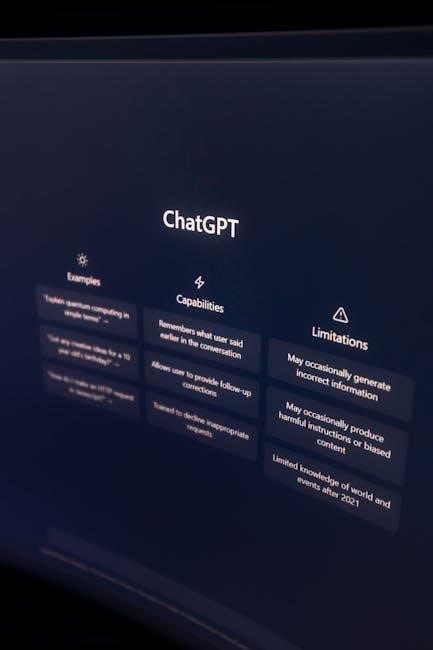
ChatGPT‚ an AI chatbot developed by OpenAI‚ has rapidly become a ubiquitous tool since its late 2022 launch. This advanced generative AI has revolutionized how users interact with information‚ making sophisticated artificial intelligence accessible to the masses for various tasks‚ including content generation and problem-solving.
What is ChatGPT?
ChatGPT is an advanced artificial intelligence chatbot developed by OpenAI‚ initially launched to the public on November 30‚ 2022. Designed to interact with users in a conversational format‚ it leverages a sophisticated neural network to understand context‚ nuance‚ and even humor‚ making interactions feel remarkably human-like. Its intuitive dialogue-based interface allows it to respond to a wide array of queries‚ engaging in dynamic discussions and providing comprehensive answers on almost any topic.
This powerful AI assistant has quickly gained widespread adoption due to its versatile capabilities. ChatGPT excels at generating texts of varying complexity and themes‚ from crafting detailed reports and abstracts to composing creative stories and even writing functional code. It can assist users in exploring ideas‚ solving complex problems‚ and learning faster across numerous domains. While initially offered for free‚ OpenAI introduced a paid subscription‚ ChatGPT Plus‚ in February 2023‚ offering guaranteed access to the latest models and exclusive features. This AI chatbot has become an indispensable tool‚ enabling millions to enhance productivity and foster creativity in their daily work.
Understanding PDF File Format
The Portable Document Format (PDF) is a widely recognized and utilized file format designed for presenting documents in a manner independent of application software‚ hardware‚ and operating systems. Identified by its common file extension‚ `.pdf`‚ and often associated with an iconic Adobe symbol‚ it serves as a de facto standard for digital documents across various platforms. Its official MIME type‚ `application/pdf`‚ further solidifies its identity in the digital landscape.
PDFs are frequently employed for sharing a diverse range of information‚ from comprehensive guides such as “Getting Started with ChatGPT” and insightful presentations to crucial official documents and rules‚ like those for feedback contests. They are also a popular format for distributing practical resources‚ including collections of “50 ChatGPT Prompts.” The format’s ability to preserve the original layout and formatting of documents makes it ideal for consistent viewing and printing‚ ensuring content integrity across devices.
Users commonly encounter PDFs both as downloadable files and as online resources accessible via web addresses. The format’s prevalence means that interacting with these documents‚ whether for consumption or creation‚ is a fundamental digital activity‚ highlighting its importance in information exchange.
ChatGPT’s Native PDF Interaction Limitations
Natively‚ ChatGPT cannot directly upload or read PDF files. Despite user interest in making the AI chatbot process PDF documents‚ it inherently lacks this built-in capability. This is a primary limitation for direct interaction.
Inability to Upload PDF Files Directly
Since its public release‚ ChatGPT has captivated millions with its versatile capabilities. However‚ a common query among users‚ especially those interacting with extensive documentation‚ revolves around its capacity to handle PDF files. A significant limitation is ChatGPT’s inherent inability to directly upload PDF documents. Users often wonder how to upload a PDF to ChatGPT‚ expecting a seamless integration given the AI’s advanced text processing prowess. Yet‚ the current architecture of the core ChatGPT model does not support a direct file upload mechanism for PDFs. This means that unlike some other platforms or specialized tools‚ users cannot simply drag and drop a PDF into the ChatGPT interface and expect it to be parsed or analyzed directly. This poses a considerable challenge for individuals and businesses aiming to leverage ChatGPT for tasks like summarizing reports‚ extracting data from official documents‚ or reviewing presentations that are typically distributed in PDF format. The absence of this direct upload feature necessitates alternative methods for bringing PDF content into ChatGPT’s conversational scope‚ prompting a search for workarounds and indirect approaches rather than straightforward file handling. This fundamental design choice impacts the immediate accessibility of PDF-based information for comprehensive AI processing.
The Challenge of Making ChatGPT Read PDFs
The challenge of making ChatGPT read PDF files directly stems from its architectural design‚ which prioritizes text-based input rather than document parsing. Despite its advanced natural language processing‚ the core AI model lacks built-in functionalities to interpret the intricate structure of a PDF. Users often seek to upload a PDF to ChatGPT for summarization‚ analysis‚ or specific information extraction‚ only to encounter this fundamental barrier. A PDF‚ being a fixed-layout document‚ can contain text‚ images‚ and complex formatting‚ which isn’t readily digestible by a conversational AI without an intermediary step. Consequently‚ the task of having ChatGPT “read” a PDF typically demands manual intervention. This involves painstakingly copying and pasting relevant sections of text from the PDF into the chat interface‚ or employing external tools to convert the PDF content into a plain text format. This multi-step process detracts from the seamless interaction expected from an AI assistant and introduces inefficiencies‚ making it a significant hurdle for those aiming to leverage ChatGPT for document-centric workflows. The absence of direct PDF interpretation remains a notable limitation for widespread adoption in certain professional contexts.
Leveraging Online PDFs with ChatGPT
If a PDF file is available online‚ getting ChatGPT to reference it becomes notably easier. Users can provide the AI with a direct URL to the web address where the PDF resides‚ enabling ChatGPT to access and process its content.
Referencing Online PDF Files via URL
ChatGPT’s inherent limitations regarding direct PDF file uploads necessitate alternative methods for interacting with document content. One highly effective approach is leveraging online PDF files by providing ChatGPT with their direct Uniform Resource Locator (URL). This method is remarkably straightforward: if a PDF document is hosted on the internet‚ users can simply share its web address with the AI. ChatGPT can then access the content at that specific URL‚ effectively enabling it to “read” and process the information contained within the online PDF. This capability significantly expands the AI’s utility‚ allowing it to summarize articles‚ extract key data‚ or answer questions based on the document’s content‚ all without requiring a direct upload. It’s a pragmatic solution that bypasses the native inability to handle local files‚ transforming publicly accessible PDFs into valuable resources for AI-driven analysis. The ease of referencing online PDFs via a URL makes ChatGPT a more versatile tool for research‚ content creation‚ and information retrieval from a vast array of web-based documents‚ including academic papers‚ reports‚ and guides. This method underscores the evolving integration of AI with web-based data‚ making information more readily digestible and actionable.

Enhancing PDF Capabilities with ChatGPT Plugins
ChatGPT’s PDF capabilities are greatly enhanced by handy plug-ins. These tools allow the AI chatbot to search‚ summarize‚ and even create PDF documents. This expands its utility‚ making it a powerful assistant for managing digital files efficiently.
Utilizing Handy Plug-ins for PDF Interaction
ChatGPT’s interaction with PDF files is significantly enhanced by “handy plug-ins‚” crucial tools that overcome the AI’s native inability to directly upload or read such documents. These integrations transform ChatGPT into a versatile document assistant‚ enabling it to perform a range of actions. Users can now leverage the AI to effectively search within PDFs‚ extracting specific information and keywords efficiently from extensive reports and guides‚ saving considerable user time.
Furthermore‚ these plug-ins facilitate the summarization of complex PDF content‚ providing concise overviews invaluable for quickly grasping the essence of lengthy documents. Beyond analysis‚ certain plug-ins empower ChatGPT to create entirely new PDF documents based on its generated text. This streamlines workflows for report generation or presentation preparation. Essentially‚ these tools unlock deeper analytical and generative functions for structured documents‚ greatly enhancing productivity and making the AI a comprehensive solution for managing and creating PDF-formatted information across applications.
Searching Within PDF Documents
While ChatGPT lacks the inherent ability to directly search inside PDF files‚ its functionality is significantly expanded through the integration of specialized plug-ins. These handy tools empower the AI chatbot to effectively perform searches within the content of various PDF documents. This capability is particularly invaluable when dealing with large volumes of text‚ such as research papers‚ user manuals‚ official rules‚ or lengthy reports‚ where manually sifting through pages for specific information would be incredibly time-consuming.
By utilizing these plug-ins‚ users can prompt ChatGPT to scan a provided PDF (often referenced via a URL or processed by the plugin) for keywords‚ phrases‚ or even contextual information. The AI then processes the document‚ identifying and extracting the relevant sections or data points. This transforms ChatGPT into an efficient research assistant‚ enabling users to quickly pinpoint critical details and retrieve precise answers from structured PDF resources without the need for exhaustive manual reading. It dramatically enhances productivity and the utility of PDFs as informational assets.
Summarizing Content from PDF Files
One of the most powerful applications of ChatGPT‚ when augmented with appropriate plug-ins‚ is its ability to summarize content directly from PDF files. While ChatGPT itself cannot natively “read” or process PDFs‚ specialized plug-ins bridge this gap‚ allowing the AI to ingest the text from these documents and generate concise summaries. This functionality is a game-changer for users who frequently deal with extensive PDF resources‚ such as research papers‚ detailed reports‚ lengthy presentations‚ or official documents.
Instead of spending hours manually sifting through pages‚ users can leverage ChatGPT to extract the core ideas‚ main arguments‚ and key conclusions from a PDF. By providing the AI with access to an online PDF via a URL or through a plug-in’s processing capabilities‚ ChatGPT can quickly analyze the content and distill it into an easily digestible overview. This significantly enhances productivity‚ aids in rapid comprehension‚ and allows for efficient information extraction‚ making complex or lengthy PDF documents much more manageable and accessible for quick understanding.
Creating New PDF Documents with AI
Beyond analyzing and summarizing existing PDF files‚ ChatGPT‚ particularly when integrated with specific plug-ins‚ extends its utility to the creation of entirely new PDF documents. While ChatGPT’s core function is text generation‚ its ability to craft detailed reports‚ articles‚ guides‚ and presentations can be seamlessly converted into the PDF format with the right tools. This means that users can leverage the AI chatbot to generate content of any complexity and theme‚ and then use specialized plug-ins or connected services to format and export this output as a professional PDF document.
This capability is highly beneficial for a wide range of applications‚ such as producing official documents‚ compiling collections of ChatGPT prompts (as seen in some “filetype:pdf” examples)‚ creating instructional guides like “Getting Started with ChatGPT‚” or even developing marketing materials. The AI handles the content generation‚ while the integrated tools manage the conversion and formatting‚ streamlining the process of document creation from an AI-generated draft to a shareable‚ standardized PDF file.

PDFs as Resources for ChatGPT Users
PDFs serve as invaluable resources for ChatGPT users‚ offering guides like “Getting Started with ChatGPT‚” detailed explanations such as “What It Is and How Writers Can Use It‚” and collections of prompts. Official rules and documents for contests are also available in PDF format.
Guides and Presentations on Getting Started with ChatGPT (PDF)
PDF documents are widely utilized as foundational guides and presentations to assist new users in understanding and engaging with ChatGPT. A notable example is “Getting Started with ChatGPT.pdf‚” authored by Manish Chopra and published on February 28th‚ 2023. This introductory presentation provides a comprehensive overview of the AI chatbot‚ detailing its core functionalities and offering practical steps for effective interaction. Such resources are invaluable for demystifying the initial learning curve associated with generative AI‚ making the technology more accessible to a broader audience. These guides often cover essential topics like prompt engineering‚ explaining how to formulate effective queries to achieve desired responses. The availability of these structured introductions in PDF format ensures that users can easily download‚ review‚ and reference critical information offline‚ thereby facilitating a smoother onboarding process. These documents bridge the gap between initial curiosity and proficient application‚ transforming novices into skilled users by illustrating the foundational principles and key operations of ChatGPT. They also typically include examples‚ tips‚ and an overview of the chatbot’s versatility across various tasks‚ from writing assistance to information retrieval.
ChatGPT: What It Is and How Writers Can Use It (PDF)
The document titled “ChatGPT: What It Is and How Writers Can Use It.pdf‚” last noted around March 10‚ 2023‚ serves as a crucial resource for understanding the application of OpenAI’s AI chatbot in the writing domain. Published by Adsy‚ a guest posting service‚ this PDF specifically targets writers‚ elucidating how ChatGPT can be leveraged to enhance their craft and productivity. It details the chatbot’s capabilities in generating diverse textual content‚ from creative stories and articles to more structured pieces. For writers‚ ChatGPT presents an invaluable assistant‚ capable of producing its own narratives‚ brainstorming ideas‚ and even conceptualizing complex topics. The guide likely explores practical prompt tips‚ enabling writers to engage with the AI effectively to produce high-quality output. By making such powerful AI tools available to the masses‚ ChatGPT empowers writers to overcome creative blocks‚ expedite content creation‚ and explore new narrative avenues. This PDF underscores the transformative potential of AI in the writing industry‚ providing a clear roadmap for authors to integrate this technology into their workflow for various text-related tasks.
Collections of ChatGPT Prompts in PDF Format
The burgeoning interest in ChatGPT has led to the creation and widespread sharing of curated prompt collections‚ frequently compiled into convenient PDF formats. As early as January 27‚ 2023‚ resources like “Best 50 ChatGPT Prompts Filetype:PDF” were made available for free download‚ showcasing the value these compilations offer. These PDF documents are designed to guide users in crafting effective prompts‚ thereby maximizing the utility of the AI chatbot. They serve as invaluable tools for individuals looking to explore various applications of ChatGPT‚ from generating creative content and assisting with programming to streamlining business operations and even finding avenues for making money online. The structured nature of PDF files makes them ideal for organizing and presenting a diverse array of prompts‚ categorized perhaps by topic‚ complexity‚ or desired outcome. By providing readily accessible and easily distributable collections‚ these PDF guides empower users to harness ChatGPT’s capabilities more efficiently‚ fostering better interactions and more relevant outputs. They democratize access to advanced prompting techniques‚ ensuring that a broader audience can effectively engage with and benefit from OpenAI’s powerful AI assistant.
Official Documents and Rules in PDF Format
The digital landscape surrounding ChatGPT often includes critical official documents and guidelines‚ frequently distributed and preserved in the ubiquitous PDF format. These documents are essential for users and stakeholders to understand the operational frameworks‚ terms of service‚ and specific rules governing various aspects related to the AI platform. A notable example is the “live ChatGPT Feedback Contest: Official Rules‚” which was made available by OpenAI in PDF format‚ as evidenced by the URL pointing to “ChatGPT_Feedback_Contest_Rules.pdf”. This particular document‚ accessible as early as December 30‚ 2022‚ and archived by January 18‚ 2023‚ outlined the specific conditions for participation and feedback submission. The choice of PDF for such official communications is strategic; it ensures that the formatting‚ layout‚ and integrity of the content remain consistent across different viewing platforms and devices. This fixed-layout characteristic is crucial for legal texts‚ official announcements‚ and contest rules‚ where precision and an unalterable presentation are paramount. Thus‚ users frequently encounter important regulatory information‚ policy statements‚ and detailed guidelines concerning ChatGPT’s usage‚ contests‚ or updates‚ reliably presented within PDF files‚ maintaining clarity and authority for all.
ChatGPT Output and History Management
ChatGPT offers features for managing output and history. Users can download conversation logs‚ including to PDF format‚ or generate sharable links. This enables easy archiving and sharing of valuable AI interactions.
Downloading ChatGPT History to PDF
The ability to download ChatGPT conversation history into a PDF file is a highly sought-after feature for many users. This functionality addresses the practical challenge of preserving extensive AI interactions that often contain valuable information‚ creative outputs‚ or critical data. Given that manually “snapshotting” an entire long conversation can be cumbersome and inefficient‚ tools and methods have emerged to facilitate the conversion of these digital dialogues into a more manageable and shareable format. By downloading chat history to PDF‚ users gain a permanent‚ offline record of their exchanges with the AI. These PDF documents can then be easily archived for personal reference‚ included in project documentation‚ or shared with colleagues and collaborators. This capability ensures that the complete context of a discussion‚ from the initial prompt to the final AI response‚ is retained in a universally accessible format‚ enhancing the utility and longevity of ChatGPT’s contributions to various tasks and projects.
Sharing ChatGPT Conversations as PDF
Sharing ChatGPT conversations as PDF files provides an invaluable method for disseminating AI-generated content in a structured and professional format. When users wish to share their extensive chats‚ the common practice of screenshotting often proves inadequate‚ as it becomes exceedingly difficult to capture the entirety of a lengthy dialogue effectively. A PDF conversion addresses this challenge directly‚ consolidating the entire conversation thread into a single‚ cohesive document. This capability is particularly beneficial for academic research‚ project collaboration‚ or client presentations‚ where a complete and easily shareable record is essential. The PDF format ensures that the context‚ flow‚ and specific details of the interaction are preserved accurately‚ making it effortless for recipients to review the exchange without needing access to the original ChatGPT interface. This functionality transforms transient digital interactions into permanent‚ portable resources that can be emailed‚ stored‚ or printed‚ significantly enhancing the utility and impact of ChatGPT’s contributions across various professional and personal applications.
The Evolving Landscape of AI and Documents
AI chatbots like ChatGPT‚ Google Gemini‚ and similar tools are making artificial intelligence widely accessible. They enable users to obtain diverse responses on nearly any topic‚ transforming how we interact with and manage digital documents‚ making sophisticated AI available to the masses.
AI Chatbots Making Tools Available to Masses
The advent of sophisticated AI chatbots‚ such as OpenAI’s ChatGPT and Google Gemini‚ has profoundly transformed the landscape of artificial intelligence‚ making its powerful capabilities readily accessible to a broad public. Since its public release in late 2022‚ ChatGPT has experienced rapid growth and widespread adoption‚ quickly becoming an indispensable assistant for millions globally. These intelligent systems democratize access to advanced computational power‚ allowing users to obtain instant answers and detailed responses on an immense variety of topics imaginable; From writing complex texts and programming code to generating creative content and conceptualizing innovative ideas‚ ChatGPT empowers individuals across diverse fields. It helps users explore ideas‚ solve problems efficiently‚ and learn faster‚ moving beyond traditional text-based interfaces to offer a more intuitive‚ conversational interaction. This crucial shift ensures that advanced AI tools are no longer exclusive to specialists‚ but rather essential everyday utilities for everyone‚ fostering unprecedented levels of productivity and creativity in both personal and professional contexts. The widespread availability of such robust AI through highly user-friendly interfaces signifies a truly monumental step in technological evolution‚ enabling significant engagement with cutting-edge artificial intelligence for all daily tasks.